

1066: Be There 🏰
Ever wanted to walk alongside Harold, William and the Norman fleet?
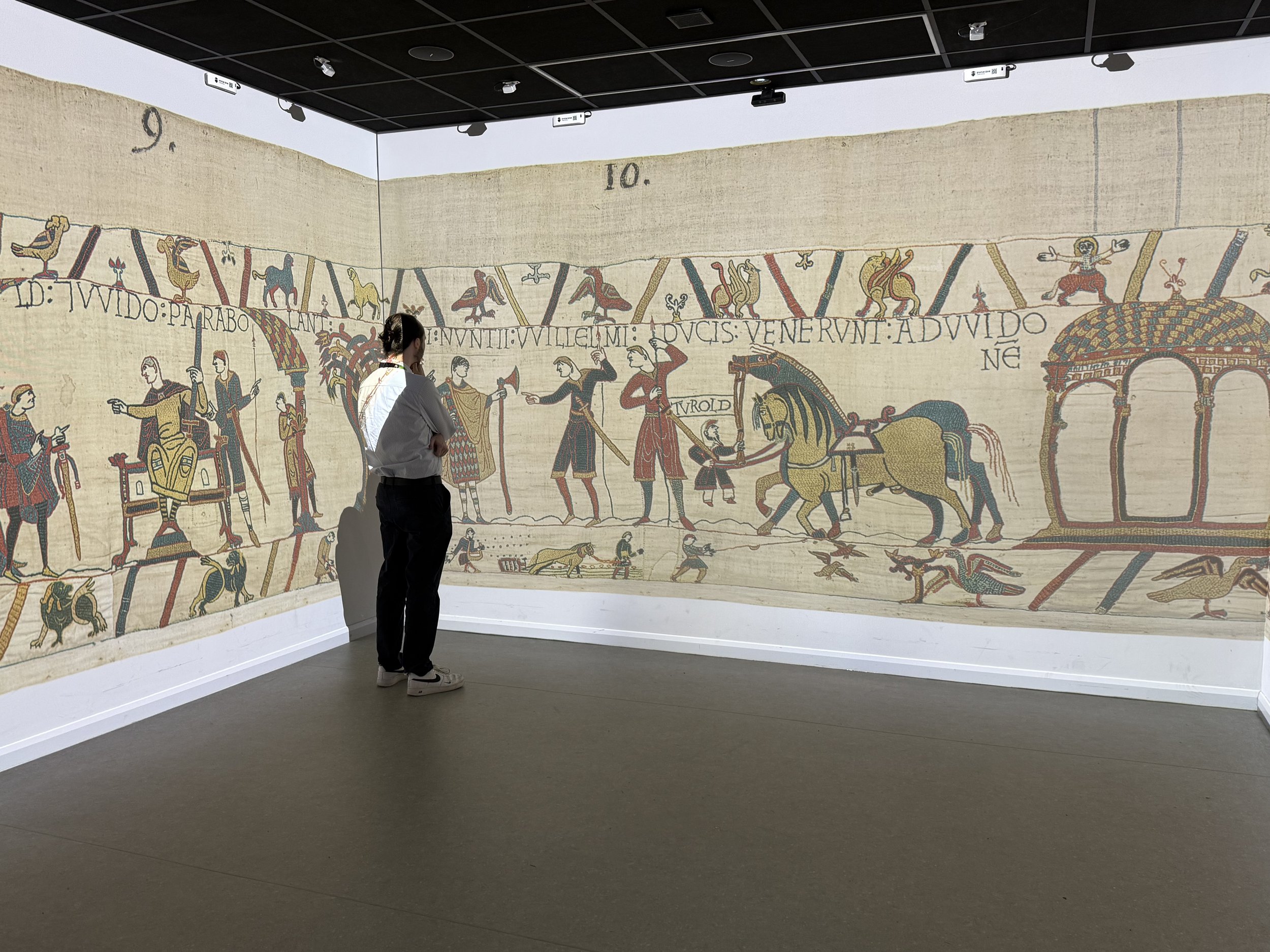
Our Immersive Room brings the Bayeux Tapestry to life around you, turning nearly 70 metres of embroidered storytelling into an experience you can explore.
See the Norman invasion unfold around you, from ships and battles to the famous comet and one very unlucky king.
Free lunchtime drop-ins | 12:15–1:00pm
No booking needed. Grab your lunch, bring your friends and step into the story.
Lewes, Room LC212A
Wed 7, Thu 8, Tue 13, Wed 14, Thu 15 October
Station Plaza, Room SP3079
Wed 7, Thu 8, Tue 13, Wed 14, Thu 15, Tue 20, Thu 22 October
Eastbourne, Room EV115
Wed 7, Thu 8, Tue 13, Wed 14, Thu 15, Tue 20, Thu 22 October
Ore Valley, Room OV253A
Thu 8, Tue 13, Thu 15, Tue 20, Thu 22 October
What is the Bayeux Tapestry?
For the first time in nearly a millennium, this legendary 70-metre-long masterpiece has left France and is currently in London on a historic, once-in-a-lifetime loan to the British Museum.
While museum nerds globally are losing their minds over it, it’s actually highly relevant to us.
The climax of this entire ancient "comic strip" is our literal backyard. It tells the chaotic story of the Norman Conquest of 1066, culminating in the Battle of Hastings. But because we live here, we usually just get the standard textbook version. The tapestry hides a few secrets about our local history that you might not know:
It’s a local "Made in Britain" product: The artwork was created almost exactly at the time of the events, commissioned in the 1070s right after the conquest. And even though it’s spent centuries in France and bears a French name, historians widely agree it was actually hand-stitched by Anglo-Saxon needleworkers right here in the South East of England (likely in Canterbury).
The "Arrow in the Eye" might be fake news: We all grew up learning that King Harold died from an arrow directly to the eye at Hastings. But if you look closely at the linen, that specific arrow was actually added during a restoration project centuries later. The original stitching likely just showed him being hacked down by a sword.
So, why does everyone freak out about it?
Aside from being nearly 1,000 years old, it’s essentially the world’s oldest surviving blockbuster movie. Most medieval history is just dry text written by monks, but the tapestry gives us a vibrant, full-colour, graphic look at real 11th-century life—down to the specific armor, the ships, and even the chaotic violence of the battlefield.
How did it even survive this long?
Honestly, it’s a miracle it’s still in one piece. For about 700 years, it was stored in a wooden chest in the treasury of Bayeux Cathedral in France and only taken out once a year to hang up for the locals.
After that, it survived an absolute gauntlet of historical disasters:
The French Revolution: Rioting revolutionaries dragged it out of the cathedral and were literally about to cut it up to use as a canvas tarp to cover an ammunition wagon. A local lawyer rushed in and saved it just in time.
The Nazi Obsession: During World War II, the Gestapo and SS commander Heinrich Himmler became obsessed with it, believing the tapestry proved "Germanic superiority". They seized it and hid it in a remote chateau, eventually moving it to the cellars of the Louvre in Paris. The French Resistance and Allied forces managed to liberate Paris just 48 hours before the Nazis could pack it onto a train to Berlin!
Whether you ever bother jumping on a train to London to see it or not, it's pretty wild to think that the most talked-about historical artifact in the world right now is entirely about the ground we walk on every day.